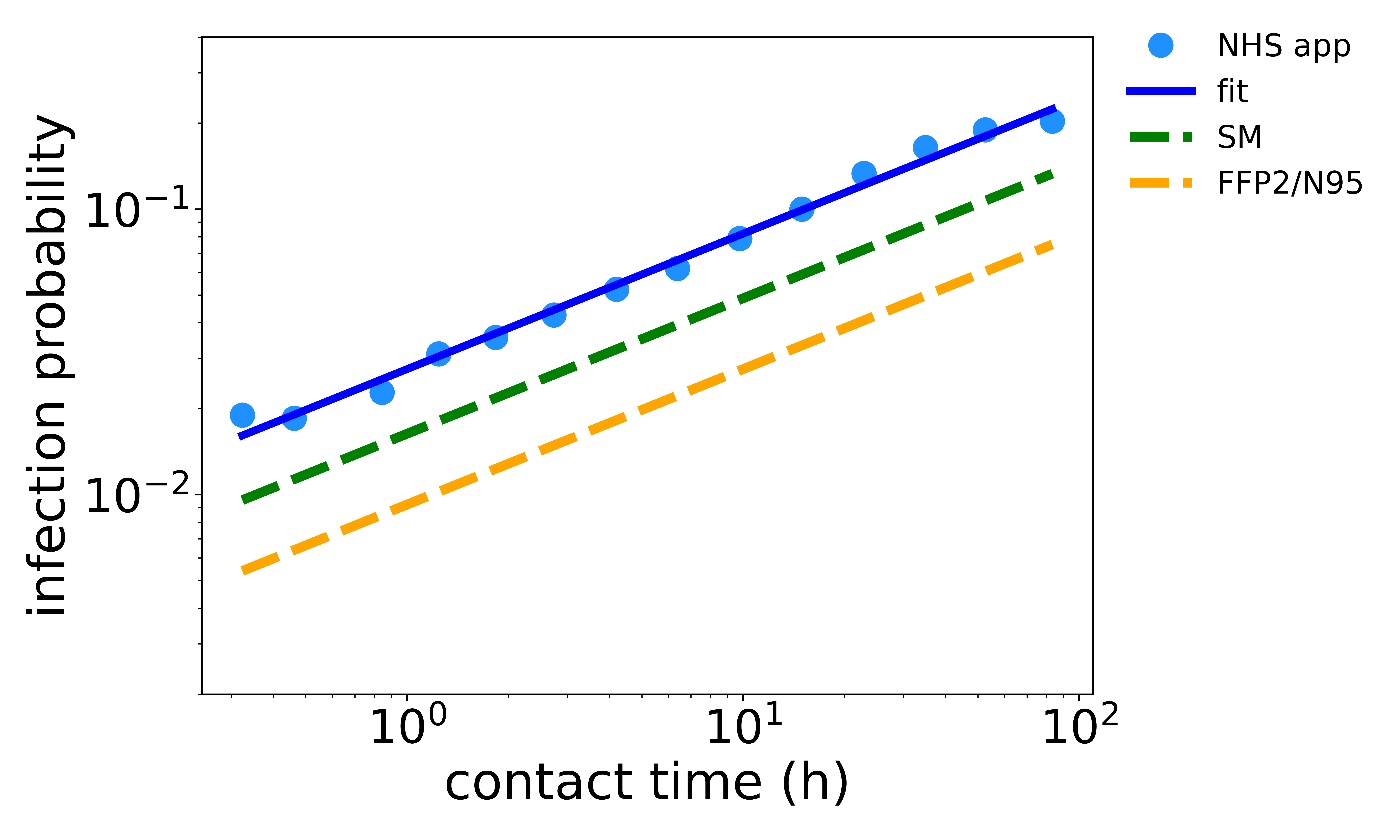
During the pandemic, many of us in the UK used the NHS COVID app. This used Bluetooth to pick nearby app users and you could report infections in it. D during the pandemic, it produced data both on millions of contacts between app users, and on the resulting infections. The data was analysed by a team at the UK HSA (then Public Health England) and the University of Oxford, resulting in the data points shown in pale blue above (published here, and see here for a summary).
The points show the probability that you become infected, as a function of the time you spend in the presence of someone infected with COVID. As they showed, the data is pretty well fit by a power law, tβ, with exponent β ~ 0.47.
Statistical physicists have shown that power laws in time arise quite naturally when there is a very broad distribution of rates. Here this would imply that some contacts are high risk, while others are much lower risk. High risk would mean being close to an infected person in a poorly ventilated room, while being far from an infected person in a very well ventilated room would be much less risky.
Here high and low risk corresponds to high and low transmission rates. This is useful as with a model for high and low transmission rates, you can use the model to estimate the effect of interventions such as mask use. Which I do above (on arxiv). The bottom line is that I estimate that wearing a reasonably well-fitting FFP2 or N95 mask reduces your chance of catching COVID by a factor of about three.
This is approximately independent of the duration of the contact between you and an infected person – as shown by the green line showing the model prediction above, which is parallel to the fit to the data. The orange line shows the prediction for wearing a surgical mask (SM), these are much less effective, so reduce the risk by much less.
Slides from an old 2020 talk
The pdf of the slides of my talk entitled Some simple physics of corona virus transmission at SOFT MATTER: THE UNSEEN SCIENCE ALL AROUND US is here. I cover both simple models of person-to-person transmission of SARS-CoV-2, and of masks/face coverings, but it is now out of date.
You can see my blog for latest thoughts on COVID-19 transmission. It is a tough interdisciplinary field (ranging from fluid mechanics to social science, as well as virology), which received little funding before the pandemic, and now also receives little funding.
 richardsear.me