
Website of Richard Sear
I am a computational soft-matter physics/biological physics academic at the University of Surrey. At the moment I am mainly working on two things. The first is moving colloids around, mostly with the Hartree Centre’s Patrick Warren. The second is the airborne (in aerosols) transmission of diseases such as COVID. I am a member of the EPSRC Centre for Doctoral Training in Aerosol Science (led from Bristol), which has funding for October starts to do a PhD with colleagues and I.
I have a blog, Chance & Necessity. Please take a look there to see what I am thinking about at the moment.
Moving colloids & DNA around
(research on moving colloids, DNA etc around in solution, with (salt) gradients)
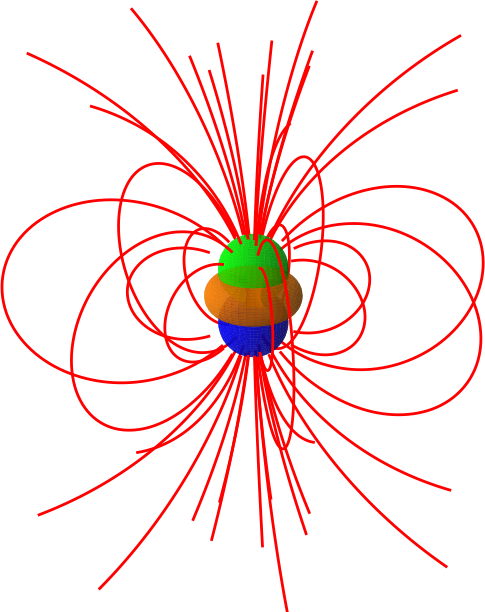
Patrick Warren pointed out that when concentration gradients of different salts are crossed, then the solution with these gradients is effectively instantaneously permeated by electric currents – which are absent if there is only one salt. We have shown that the maths that describes these electric currents is very like textbook magnetism, so a pair of different dissolving salt crystals is surrounded by currents like the magnetic field lines around a magnetic dipole.

COVID-19 research
(research on physical aspects of airborne transmission of infectious diseases, including flu, tuberculosis,..)
Masks & how much they reduce transmission
Transmission of a virus from an infected to a susceptible person is (mostly) transport physics, so fluid mechanics. And it is horribly variable so techniques from statistical physics are useful. I have applied both to understand why cloth masks are so bad (wear an FFP2/N95, not a cloth or surgical mask!), and to use data from the pandemic era’s NHS COVID app to predict how effective masks and improved ventilation are.
Soft matter physics of airborne transmission
Viruses need to survive for between seconds and at least minutes, maybe longer, to cross the air from an infected person to a new person to infect. They are in tiny droplets of mucus, which will dry out in these seconds. I am interested in how viruses do or do not survive this drying out. It is more complex than it sounds. Unfortunately.

University league tables
The university league tables in newspapers are misleading in a number of ways, for example they are not really university league tables. They are league tables of a selected (by the newspaper) set of higher education institutes (HEIs). For example, both Hartpury University and College, and Imperial College offer degrees, but only Imperial is in The Guardian‘s 2023 “university league table”. This seems rather unfair on Hartpury.
The algorithms used to generate league tables contain arbitrary parameters in them. These can be used/abused to make any university you like the best university.

Teaching
This website is mostly about my research. If you are a Surrey student looking for teaching material, the notes, question sheets etc, for the courses I teach, are on the SurreyLearn modules. But have developed a mini-project in fluid mechanics, to do stuff like this:
I should say that the opinions expressed here are my own, and not necessarily those of my employer.
 richardsear.me